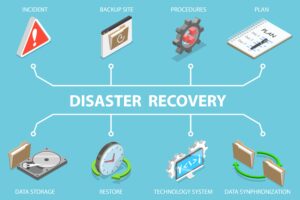
An IT disaster recovery plan outlines the strategies, procedures, and protocols a company follows to restore its IT systems and infrastructure after a disruptive event. Its main goal is to recover critical services, restore data, and return business operations to normal following incidents such as cyberattacks, hardware failures, natural disasters, or even human error. A well-crafted plan reduces downtime, minimizes risk, safeguards data integrity, and supports overall business continuity.
When you turn to MSEDP, we can help you develop a disaster recovery plan. Get your business back up and running quickly after a data loss with MSEDP’s comprehensive disaster recovery services. Threats like viruses or power outages can be just as damaging to your systems as a major fire or flood. Our backup and disaster recovery (BDR) solutions safeguard your company’s programs and files, ensuring they can be restored fast when an unexpected crisis occurs.
MSEDP provides disaster recovery, data backup protection, and a full range of IT support services for businesses on Long Island, throughout New York, and across the United States. Protect your data—and your website—with reliable, proactive solutions.
How to Develop an IT Disaster Recovery Plan
IT disasters can occur without warning, threatening business operations and leading to major data loss. With a strong IT disaster recovery plan in place, organizations can maintain business continuity and significantly reduce downtime when these events happen. An effective plan should outline clear protocols for data backups, recovery steps, and internal and external communication. It’s also essential to regularly test and update the plan to address new risks and ensure it remains effective. The IT team at MSEDP will work with you every step of the way during the development of an IT disaster recovery plan. Ensuring all aspects are properly covered.
5 Reasons Why IT Disaster Recovery Planning is Important
IT disaster recovery planning is crucial for businesses for various reasons. Here are five key reasons why IT disaster recovery planning is important for businesses both big and small:
- Operational Continuity: Having an IT disaster recovery plan in place ensures all business operations continue with minimal disruption. Keeping the workflow organized and secure.
- Data Protection: With disaster recovery planning in place, you have a plan for safeguarding sensitive and critical data from loss or corruption.
- Emergency Response: An IT disaster recovery plan helps disaster recovery teams in minimizing the effect of IT disasters on business operations.
- Regulatory Compliance: Proper IT disaster recovery planning helps any business meet legal and regulatory requirements for data protection compliance and business continuity.
- Customer Trust: An IT disaster recovery plan demonstrates preparedness and resilience, which helps to keep customer confidence high even during a crisis.
Common IT Disaster Recovery Strategies
Businesses can employ various IT disaster recovery strategies to ensure business continuity. Here is a rundown of some of the more common strategies for disaster recovery.
- Backup and restore: This is when businesses regularly back up data for disaster recovery and restore it when it is needed.
- Cloud-based disaster recovery: The use of cloud services for scalable and flexible recovery options.
- Incident response: An incident response plan outlines the steps for detecting, analyzing, containing, and recovering from cybersecurity incidents.
- High availability solutions: This strategy is the implementation of systems that ensure continuous operation even during failures.
- Virtualization: The utilization of virtual machines to quickly restore IT services.
- Redundancy: This strategy is the implementation of redundant systems and components in order to prevent single points of failure.
- Replication: The duplication of data and systems to a secondary location for quick recovery.
When you turn to MSEDP for your disaster recovery needs, we can pinpoint the right strategy and implement it effectively. Our IT team has years of experience handling disaster recovery efforts and can quickly draw up a strategy that works for your business.
Disaster Recovery Planning Components
 Before beginning the implementation of a disaster recovery plan, it is important to understand the key components driving the plan. This sort of template provides structure for the elements and will help any business thrive by fully understanding the details that go into planning for disaster recovery efforts. Here are the key components for general disaster recovery planning. At MSEDP, we will tailor the plan to meet your specific needs.
Data Backup and Recovery
Clearly defining backup procedures is essential to ensuring your business consistently and securely protects its critical data. Performing regular on-site and off-site backups allows for reliable data restoration in the event of loss or corruption. Utilizing a mix of full, incremental, and differential backup strategies helps safeguard important information, reduce recovery time, and maintain data integrity.
Information systems play a central role in effective data backup and recovery. They provide the infrastructure and tools needed to manage data, communications, and operations before, during, and after a disaster. With automated backup capabilities, real-time monitoring, and rapid data restoration, these systems help ensure that key business functions can resume with minimal disruption.
Risk Assessment
To better understand your company’s risks and prioritize recovery efforts, it is vital to conduct a thorough risk assessment. This assessment identifies potential threats and vulnerabilities within IT systems and its infrastructure. This assessment typically evaluates both on-premises and data center environments. By doing so, the risk assessment is able to provide a complete picture of possible disaster scenarios.
Along with identifying vulnerabilities, a risk assessment should also measure the likelihood and potential impact of each risk on business operations. This allows for the prioritization of threats and the allocation of resources where they’re needed most.
Continuity Plan
A continuity plan involves developing strategies to ensure the uninterrupted operation of critical business functions during and after an IT disaster. These continuity plans identify alternative processes, resources, and recovery procedures in order to maintain all operations. Having a well-defined disaster recovery plan and procedure outlines the steps to restore critical systems and data, ultimately ensuring smooth and efficient recovery.
In general, continuity plans include three elements:
- Alternative processes
- Resource allocation
- Recovery procedures
Alternative processes involve identifying and documenting alternative workflows in order to keep critical functions up and running. Resource allocation ensures all necessary resources, such as personnel and equipment, are available and can be quickly mobilized. Lastly, recovery procedures require outlining specific steps in order to restore IT systems and data. Then there is also the need to select a disaster recovery site, which is a secondary location where a company can recover its IT infrastructure and resume business operations during a disaster. This site needs to be far away from the primary location. By doing so, it minimizes the risk of being affected by the same disaster. All of these elements work together and help to ensure the continuity plan is effective once implemented.
Communication Plan
Communication plans establish notification procedures and communication channels to ensure that internal and external stakeholders are informed and coordinated during any disaster recovery efforts. Having effective communication plans in place manages expectations, provides updates on the recovery process, and maintains trust during a disaster.
Testing and Training
Regular testing and training exercises are essential for validating the effectiveness of a disaster recovery plan, as it ensures employees are prepared to respond. Drills and simulations help uncover weaknesses and areas that need improvement, which makes sure the plan performs as expected during a real disaster. Following each test—or any actual incident—IT teams can create postmortem reports to document findings. These reports offer valuable insights into the plan’s strengths and shortcomings, supporting ongoing refinement and continuous improvement. At MSEDP, we will work with you to make sure that you have the right training to help in case there is a problem.
For any IT company, staying on top of recent trends in the realm of tech is crucial for day-to-day operations. There are trends in ransomware, data regulations, and AI which all have a major impact on disaster recovery teams. With that in mind, the MSEDP IT team stays on the cutting edge of these trends. Do not let the rapidly changing IT landscape hurt your disaster recovery initiatives by trusting an IT team that falls behind. Let a team of professionals keep you in front of any important trends in the universe of disaster recovery.
As IT trends continually evolve and improve, the strategic importance of disaster recovery has grown considerably over the years. Advancements in technology have greatly automated the processes that keep systems and networks running smoothly. Those same technologies aid in the recovery process for servers, networks, applications, databases, edge computing and the cloud. Disaster recovery, or DR, was the first term used to describe initiatives to protect the integrity and operational stability of mainframe computing systems and associated devices. Over the years, disaster recovery has focused more on an organization's technology infrastructure, how to protect it, how to prevent disruptions and how to recover the infrastructure following an incident. Here are 10 important disaster recovery trends we at MSEDP follow that keep our customers ahead of the game.
1) Improving Recovery Speeds
With greater quantities of data and increasingly complex systems, the need for rapid recovery has also increased. Based on previously-approved recovery time objectives, IT companies can assess their current infrastructures and recovery capabilities. If testing shows that the speed of recovery is too slow, managers must analyze and consider other options such as new backup strategies and greater network bandwidth to increase speed and reduce latency.
As with anything involving faster recovery, costs to achieve the new recovery time objectives may be significant. Organizations may need to balance cloud-based backup storage with on-site data backup to fully achieve recovery time objectives. The same is true with backed-up systems, databases and other mission-critical resources. When you turn to MSEDP's IT support team, we will come to a decision that best works for your needs.
2) Instant Database Recovery
Recovery speed is a function of the systems backing up data and applications and the network bandwidth used for moving resources from one environment (the backup location) to another one (the production system). Instant database recovery is a growing trend in this area of disaster recovery. Achieving the fastest database recovery can be done using a third-party service or a hybrid of on-site storage coupled with a cloud-based backup tool. Our IT team will access your current situation and set up procedures for instant database recovery.
3) Data Protection as Part of Data Management
One of the most important international IT standards is General Data Protection Regulation. This applies to any organization that does business with a European Union nation or EU-based business. Its rules and regulations impact many global organizations and underscores the overall importance of data protection. Organizations must address data protection, storage, backup, security and even data destruction in a disaster recovery plan. In general, the General Data Protection Regulation is among the most well-known of such regulations, since it applies to so many organizations. And due to its worldwide reach, its penalties for noncompliance can be costly. Our in-house IT team will ensure compliance.
4) Greater Compliance with Standards
There are many disaster recovery standards, regulations and frameworks that exist which generally address disaster recovery. Knowledge of and compliance with these aspects will be increasingly important in the coming years. In addition to General Data Protection Regulation, which has stiff penalties for noncompliance, IT professionals like us will keep up to date on the many other domestic and international standards that impact operations. These may include standards and regulations from organizations such as the National Institute of Standards and Technology and ISO. Compliance with one or more standards has become increasingly important, especially from an audit perspective. And MSEDP will ensure that you stay ahead of this trend and comply with whatever standards or regulations present themselves.
 5) Ransomware Recovery
A growing number of applications and tools are available to address the major challenges presented by ransomware. There are different ways to enter an organization's technology infrastructure, such as a combination of tools, policies and procedures. All of which are necessary to stay ahead of attackers. A secure network perimeter, intrusion detection and prevention systems and strong firewalls may be a good start in this area. However, over the years hackers have become increasingly sophisticated with measures to bypass security protocols. They can often find holes to penetrate even the most secure perimeters, which means you need ransomware recovery that matches.
The challenge when trying to ward off hackers is to regularly update cybersecurity resources to ensure they remain operational and limit the overall downtime when an attack inevitably occurs. This is yet another reason to keep current with system patching, especially in systems that address security. All these actions must be supplemented with policies and procedures, plus senior management support in case an attack does occur. All aspects the team at MSEDP can ably handle.
6) Increased Testing
Testing and exercising disaster recovery plans and procedures ensures that IT infrastructure components can be quickly and safely recovered and returned to service. Testing gives us the opportunity to validate the retrieval and recovery of backed-up data, as well as other information resources. As the amount and complexity of data and systems increase, more frequent testing is required to ensure that everything works and that recovery and resumption of systems are assured. IT organizations must keep testing higher in the priority list in the coming years to continually assure optimal performance. At MSEDP, we are constantly testing our systems to ensure they are prepared to be thrown into action. Because any delay in action can have severe consequences.
7) Endpoint Management & Security
Traditional IT initiatives focused on the computing engines. However, today's corporate environment moves more computing power to the endpoint, or edge, of IT infrastructures. While there are options available to manage and secure the endpoints, more will be needed in the coming years since many employees continue to work remotely and require a link into the IT infrastructure. We will make sure that there is security for all users no matter where they are located. Ensuring you stay current on work habits and schedules.
8) Use of Multi-Cloud Operations
Nowadays, it may be not enough to use a single cloud service. A growing disaster recovery trend is using more than one cloud service. Often deploying cloud services from multiple vendors. Depending on the application for each cloud service and each vendor's policies, users will need to carefully evaluate the costs and benefits of multiple cloud services. For example, it may be possible to back up data to more than one cloud vendor's data center. Ultimately complementing this with data backup from another cloud vendor. Ultimately strengthening your overall operations.
As professional IT managers, we must base the decision for each strategy on business requirements. This includes which systems and data we must back up, how quickly we need to retrieve and recover that data in an emergency, as well as the overall costs of the operations. An ultimate cloud environment may provide the desired security and peace of mind, but the cost might be prohibitive. Rest assured though, because MSEDP has years of experience finding the best cloud solutions for our customers.
9) Artificial Intelligence as a Disaster Recovery Tool
Perhaps the most important technology trend that will significantly impact the world of disaster recovery is artificial intelligence. AI can analyze huge amounts of data, such as company IT trouble reports, disaster recovery test results and system outage data from anywhere in the world. AI can also provide dependable strategies for increasing system reliability and recoverability. Overall, artificial intelligence is increasingly prevalent in security systems and other IT management platforms. With its increase in disaster recovery, users can be better prepared for disruptive events.
10) Collaboration Among IT Teams
Disaster recovery activities have often been pigeonholed within IT and other departments. However, with the COVID-19 pandemic and other notable cyber-attacks, it is going to be increasingly important for disaster recovery teams to collaborate, cooperate and share information with other IT teams. Breaking down the traditional internal silos will help improve disaster recovery by getting teams on the same page with regard to strategies, policies and procedures. MSEDP will continue to be a progressive agent in the world of IT and disaster recovery.
Get Professional Disaster Recovery with MSEDP
If you are looking for an IT team that is fully equipped for disaster recovery, turn to MSEDP. Safeguard your data today with a disaster recovery system that follows all of the latest trends to keep your data secure. We proudly offer enterprise-level backup and disaster recovery solutions for businesses of all sizes across the country. No business is too large or too small for a professional backup and disaster recovery system. Our premium solution can get your business up and running again in minutes rather than hours or days or even weeks. You can count on our reliable IT support team for professional assistance in all IT matters. Contact us today to learn more about disaster recovery and how we can help keep you safe. When you reach out, we can provide you with a free, no-obligation consultation to go over our data backup and disaster recovery solutions.
Of course, internet safety is a year-round issue. However, it is important to designate time to raise awareness about internet security and what you can be doing to keep your website and devices secure. There are numerous ways to keep your site and devices safe from potential dangers. But one simple way to handle these challenges is to follow these three words: Stop, think, and connect. These words come as a recommendation from The National Cyber Security Alliance. MSEDP is also here to help with all of your internet and web security needs. So please, do not hesitate to reach out to us today. Learn how to be safer on the internet and what you can do to limit outside forces from infiltrating your browsers and devices.
Stop, Think & Connect
This is a mantra of The National Cyber Security Alliance. These words raise caution and aim to help all internet users locate any dangers on the web. By following them, you can quickly pinpoint any malicious software or solicitations and make your time using the internet exponentially safer.
 Stop
Stop
I don’t want to sound hyperbolic or anything, but every time you log onto the internet it is potentially an access point for malicious attempts against you. So stopping simply means to be aware of your surroundings and understand that your actions have consequences.
Think
We have all heard “don’t talk to strangers.” Well, take that sentiment and apply it to your time on the internet. Always be a little wary of requests from strangers. However, you do also have to think about your friends, too. You may receive an unsolicited request from a “friend,” like your bank or credit card company. These solicitations will ask, unprompted, for information regarding private information. Heck, you may even receive a request of some kind from a “friend,” this time being a person you know. But it is actually a hacked account. In a nutshell, any incoming communication that is asking for action or personal information should be taken with a grain of salt. So, raise those red flags and proceed with caution.
Connect
Lastly, there is of course the connection. Which you want to be secure, especially when entering sensitive information, like passwords, credit cards, etc. So it is important that you’re on a secure site with HTTPS in the URL. Always enable strong authentication tools, like 2-Factor Authentication, biometrics, or security keys whenever possible. This holds doubly true when accessing sensitive information. On a yearly basis, there are on average 9 million Americans who have their identities stolen each year. So please, be aware of your surroundings when on the web and don’t give away valuable information without following through with these protocols.
Turn To MSEDP For Help Securing Your Internet & Devices
 What Stop, think, connect means to do is raise awareness of some danger you may come across while surfing the web. However, malicious data and software can still infiltrate even the most cautious of users. That is why it is important to have the proper security team at your side. When you turn to MSEDP, we will make sure you are fully prepared for the worse, if it comes. We offer the best in disaster recovery and cybersecurity services. So please, do not hesitate to reach out today. When you turn to us, you will be getting affordable cybersecurity. We look forward to helping you safely manage your devices.