COVID-19 Update: MSEDP is operational and committed to responding to the needs of our customers.
COVID-19 Update: MSEDP is operational and committed to responding to the needs of our customers.
hello world!

As of 2026, cloud computing has progressed well beyond basic online storage and remote hosting. It has become a sophisticated, interconnected ecosystem that supports nearly every area of modern business and technology. Today, cloud computing refers to delivering a wide range of computing services. These services include servers, storage, databases, networking, software, analytics, and AI capabilities over the internet. Rather than relying on local machines or on-site infrastructure, organizations now depend on scalable, distributed cloud platforms that are often enhanced with artificial intelligence. Key features of cloud computing in 2026 now include the following:
In 2026, cloud computing is no longer just IT infrastructure. It is the backbone of digital transformation. Businesses rely on it to run AI applications, process massive datasets, support remote and hybrid work, and innovate faster than ever. Turn to MSEDP today to get the most out of your cloud computing. Contact us today to learn more about cloud computing and its benefits for your business.
The classic IaaS, PaaS, and SaaS model still exists in 2026. However, now these models exist with modern enhancements:
Leading cloud providers now deliver solutions for nearly every need—from networking and email services to container management and serverless architectures. If your applications are delivered over the internet, cloud infrastructure is likely already central to your operations. For that reason, keeping up with the latest cloud computing trends in 2026 is more important than ever. Here are some of the more notable current trends in cloud computing.
Cloud computing trends for 2026 suggest that very few organizations will run AI workloads on their own infrastructure. This includes training custom large language models, deploying chatbots, powering recommendation systems, handling image recognition, performing natural language processing (NLP), or conducting predictive analytics.
For most use cases, cloud-based AI services offer a far more practical and cost-effective alternative to building and maintaining in-house systems. This efficiency is largely driven by the cloud’s pay-as-you-go model, which allows organizations to avoid heavy upfront hardware investments and instead pay only for the resources they consume, when they need them.
Overall, every organization has their own unique needs. And cloud computing trends show that some organizations use AI to optimize their sales development (SDR) pipelines, while others leverage it for business forecasting. This is where model training becomes important. Instead of relying on pre-trained, generic models, many companies now train custom ML models tailored to their data and objectives.
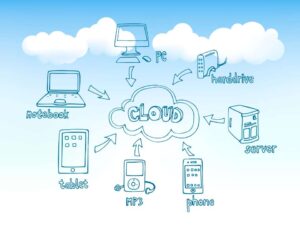 Even with a basic understanding of cloud computing, it’s clear there’s no single provider that fits every need. Still, organizations require a wide range of services. So, how do they handle this? The answer that has emerged is multi-cloud deployment, which is quickly becoming the standard approach.
That said, managing multiple platforms is far from simple. Challenges around policy enforcement, cost visibility, and governance remain significant. As a result, organizations are increasingly adopting automation tools and cloud management platforms from the outset to streamline operations.
At the core of the multi-cloud strategy are two key advantages: resilience and redundancy. If one provider experiences an outage or shifts its pricing, businesses can rely on alternative platforms to maintain continuity and avoid disruption. Ultimately keeping everything up and running without incident.
To meet the growing demand for cloud services, cloud providers continue to expand their infrastructure by building larger and more numerous data centers. Overall, an expected development in the industry. However, this rapid growth is beginning to strain the local environments where these facilities are located. Among the most significant impacts is the heavy use of groundwater, followed by increased energy consumption and emissions, and the accumulation of electronic waste.
Based on current cloud computing trends, monolithic architectures are quickly becoming a thing of the past. By 2026, the transition to cloud-native development is expected to be fully realized, with applications designed from the ground up using microservices, containers, and serverless technologies.
This approach enables faster scalability, simpler updates, and minimal downtime. With modern development tools on hand, teams can build, test, and deploy features independently, making the entire process more efficient and flexible.
Hybrid environments are a major trend in cloud computing for 2026, combining on-premises systems with public cloud platforms. This approach is gaining traction because it offers the advantages of both aspects. It has greater control over local infrastructure alongside the scalability and flexibility of the cloud.
Industries such as finance and healthcare are increasingly adopting hybrid models to meet regulatory requirements while still scaling efficiently. Sensitive data and critical workloads remain on-premises, while resource-intensive tasks are handled in the cloud, helping organizations stay agile while managing costs effectively.
Transmitting large volumes of data to centralized cloud servers for processing can introduce latency and increase costs. Edge computing addresses this challenge by moving computation closer to the source of the data, enabling faster and more efficient processing.
As a result, organizations benefit from quicker response times, lower latency, and reduced bandwidth consumption. Sectors such as logistics, manufacturing, and healthcare are already leveraging edge computing to support real-time decision-making without relying solely on distant cloud infrastructure.
For many organizations, cloud expenses are becoming a more significant part of overall budgets. As a result, cost optimization is no longer just a concern for engineering teams. It is also increasingly becoming a priority at the executive level and a key topic in C-suite decision-making. While issues like unoptimized architecture, improper rightsizing of resources, and incorrect billing models have always been relevant, the cloud computing trends with respect to key cost drivers in 2026 are as follows:
If you are looking for dependable, yet affordable, cloud computing services, turn to MSEDP today. Check out all of our IT services to learn more about how we can help your business.
Cloud computing harnesses the power of the internet to offer businesses greater data capacity and/or additional applications. This feat usually occurs without any major capital investment in hardware, software, floor space or IT personnel. Your business can get greater file storage, safer backup, faster data processing and access to more software with less initial expense using the cloud services of today. Take the safe and steady route for business management by deploying and leveraging the technologies of the cloud ecosystem today. Keep these best practices in mind to fully enjoy all cloud computing benefits. The team at MSEDP can make sure you reap the rewards of this service by setting you up to succeed. Here are 6 tips to make sure you get the most out of cloud computing for businesses.
When moving to cloud storage and servers, it is crucial to identify the most important documents, applications, and other data that require the largest space allocation for your business. You do not have to spend more money for excess cloud capacity disproportionate to your current needs. One of the great things with cloud computing is how easy it is to adjust the storage capacity as your business grows. The tech team at MSEDP will help you navigate these settings and ensure the storage set up is exactly what you need to perform. And when you need an upgrade, we are there for you.
It is smart to develop and use well-thought-out strategies for cloud adoption that can ease its IT integration with your ongoing IT structure and operations. Manage your company’s transition to the cloud while supporting it with the appropriate technologies, which is another area where our IT team can come in handy and help with these concerns. Ultimately, your long-term plans should address immediate concerns and adjust according to your evolving business. MSEDP's years of expertise handling cloud computing services can help you determine the smartest path forward.
When you turn to MSEDP as your host for cloud services, you have the ability to set up more services and applications. Get more hosted services, including hosted email services. MSEDP partners with Rackspace, which opens up the power of the cloud to host your business website, internet retail store, managed database and more. On top of that, you get the opportunity to partner with Microsoft 365 and all of the applications that come along with it. Get flexible email solutions for your business with cloud suite, which offers global email access. Other notable applications include Word, Excel, Outlook and more. Have the best set up for your business when you turn to MSEDP!
Maximize all cloud computing benefits by ensuring its functions are fully utilized as a critical part of your business’ IT systems planning and execution, which comes when you turn to MSEDP for your cloud computing needs. We will assess your workflows, organization structure, and employee roles closely. Ultimately, you are in charge and we will make amendments where you think they are necessary. Of course, we will give you our input, but the final decision on how to adjust your workflows comes down to you.
Cloud software allows more APIs that enable communication between multiple cloud-based apps, which gleans data from applications used by your clients. When you utilize the abilities of cloud services, you can gather powerful insights and analytics from this information. In turn, this helps you re-angle your customer value proposition to become more compelling and impactful in your field. Also, the level of consumer interaction on these applications can determine which tools are more frequently used. You can base your future market offering and modify your ongoing products or services on the details extracted via cloud computing.
Cloud computing offers the ability to connect with customers through multiple devices, which includes smartphones. Get the most of this convenient accessibility by formatting your web pages in flexible layouts, which is an aspect our web developers can assist you with. We can develop your website using cascading style sheets (CSS) that detect the screen size and orientation and make websites mobile friendly. This programming language instantly changes the presentation of web pages to adapt to the device and ensures a clean use no matter how someone lands on your website.
Implement cloud performance monitoring tools with specific metrics in order to fully examine the business benefits of cloud computing. Cloud data analytics can give you insights about IT infrastructure optimization that you can execute as needed. When you partner with MSEDP and our cloud computing services, we will ensure you get the most out of this service.
 Contact MSEDP To Get All the Benefits of Cloud Computing
On top of everything previously mentioned, the cloud computing benefits for business also include IT costs reduction. This is because our team handles all processes related to the core cloud infrastructure, meaning you do not have to worry about it. We also will manage the underlying components of the cloud more securely and reliably than your standard in-office data center, since we stay up to date on the latest trends and security updates in the industry. The cloud is also conveniently scalable and globally accessible, which speeds up software deployment.
The advantages of cloud computing helps to offload considerable work from IT teams, so they can concentrate on the more critical aspects of your business. Our IT team is well-equipped with all the right tools to handle these services. Allowing you and your team to handle your business on your end. By integrating cloud-based infrastructure into your operations, it can result in technological automation and standardization for your business. You can perform on the job, grow, and elevate your business more quickly with the support of cloud-based solutions. The cloud is an excellent instrument for business enhancement and MSEDP will happily work with you to come up with the best solution for your business.
MSEDP's cloud-computing professionals can recommend and install cloud applications to improve the efficiency of your business. We specialize in secure cloud email as well as cloud back-up services for added data security and greater storage. Reach out today for more information about cloud computing services. When you contact us, we can provide you with a no-obligation consultation to go over all of the details regarding cloud computing, the aforementioned tips when you turn to it, and how the benefits can improve your business.
As we head into 2024, Cloud computing is an element that simply no business can no longer ignore. The overall benefits of cloud computing have been making a huge impact for years now as the way people work has adapted with more and more companies and businesses adopting cloud technology and a remote workplace. With cloud computing, everyone at the company has access to the same internet-based platforms, data storage and applications remotely. Leading to more productivity and efficiency as a result. Capable cloud infrastructures allow companies to operate and collaborate on the go without the need to always be working from the same geographical location. For example, MSEDP utilizes cloud-based services and it has allowed our company to grow, while maintaining efficiency and security.
If you are looking to upgrade your IT services, then please get in touch with us today. Our cloud computing services can help you ring in 2024 in style. Many companies and businesses are often hesitant to fully transition to cloud computing services, but with the help of MSEDP we can ease that transition and ensure all security aspects are in place. Let's take a closer look at some common cloud computing benefits for the year 2024 and beyond and how they can be incorporated into your business strategy.
Accessing your company data via the cloud can save you both time and money. Pretty sweet, huh? It is an affordable way to save money on server space and does not require you to purchase and maintain any hardware. And it eliminates the need to invest in utilities, facilities, and larger office spaces in order to accommodate a growing business. And with our cloud computing services, you do not need to hire a full IT staff, as we can ably do it for you from our location and a price point that meets your budget. On top of all that, there is rarely any downtime for issues, which makes any company more efficient without lost time for recovery.
There is great flexibility when you opt for a cloud environment that takes care of all your computer and data storage needs, hosting, IT infrastructure. What this does is offer you more flexibility and freedom in your day-to-day operations than when you rely on local servers for hosting. With the cloud, you do not have to use human resources or build more in-office infrastructure. Instead, you can focus on the daily goals and the needs of your customer. And it raises the scalability of your business, since when you grow you simply need more space in the cloud and not locally. Allowing any business to grow faster and easier without the need to find more space.
The cloud host uses a bolstered security system in order to protect users from a data breach, theft, and any unauthorized access 24/7 and does so more efficiently than a conventional in-house system. Cloud systems have some powerful features that include access management through specific roles and permissions. Together, these functionalities will limit access to any sensitive company information to specified employees who need them for business purposes. When you turn to MSEDP for professional cloud services, you will have your data securely handled and stored. Leaving less of a risk from malicious attacks and easing any worries you may have regarding putting sensitive information into the cloud.
Another way to ease worries is with the ease and speed of disaster recovery when it comes to cloud computing, which allows for the preparation for emergencies and is able to deliver efficient data recovery solutions. Cloud services are equipped with customizable programs in order to aid and anticipate potential issues and system failures, such as power outages and natural disasters. Disaster recovery is one of the key aspects of any IT service and MSEDP can help set you up.
Without investing in cloud services, all of the essential data stays on an office computer. On the surface, this is okay and has been a mode of operation for years. However, this sort of action poses a significant issue that can hurt your business should a hacking or phishing scam take place. Or a simple malfunction can occur, wiping away important information never to be seen again. On top of that, there is also the risk of the machine itself being stolen. But when you upload data into a cloud-based server, it is safe from viruses and malware. The backup data recovery systems from MSEDP are state-of-the-art and all of your information is kept securely within our servers and can be quickly restored in case of an issue.
When you have a cloud-based service, employees can access the data anywhere simply from their smartphones or devices. So everyone is always just a click away from the information and being kept in the loop. And it enables critical updates and communication to go through, despite any distance between employees. When you have easy access to the information, everyone becomes more efficient and productive.
You can gain a competitive edge over your competition by fully utilizing cloud services to improve your operations. Cloud computing improves collaboration and communication between employees and can simplify workflow, while also automating procedures and leading to a more effective use of resources. On top of all that, cloud-based analytics and insights can help you make smarter business decisions by thoroughly improving your understanding of your consumer base and the various marketplaces. As a result, you can stay one step ahead of your competition and experience better growth and efficiency.
 8) Improved Quality Control
With the cloud, everyone on the team has access to the same consistently formatted documents and reports. All in one easy-to-find place. What this does is improve quality control, because employees do not need to save files in different versions, which may lead to confusion down the road and potentially a lack of professionalism. Better quality control helps avoid human error, too, while still tracking updates and revisions.
Cloud computing simplifies working together. Employees from different teams can read and share information securely and seamlessly on cloud-based platforms, like Microsoft 365. Certain cloud services have special spaces, too, for chatting and banter, like Microsoft Teams, which helps boost employee engagement and subsequently their happiness. When working together is easier, the whole business thrives.
Cloud applications will automatically refresh and install updates, which saves time and energy manually handling it. Or even forgetting to update and leaving yourself vulnerable to hacking due to an aspect of your security not being up to par. When you make MSEDP your MSP, we will make sure all auto updates run smoothly and on-time, so all you need to do is handle what you do best.
When you have professional cloud computing at your side, you can quickly adjust your storage and processing power in order to better suit your current needs. There is no need to buy expensive on-premises technology that will not be used on a regular basis and will eventually need to be replaced. Instead, you can scale up or down with ease depending on your resources with the cloud. This enables a more efficient working environment and more flexibility when it comes to changes in demand. And ultimately, this flexibility leads to a cost reduction and better resource management.
With cloud services on your side, you can experience faster marketing and improved service capacities. How? Well, cloud computing fortifies your resilience in the field and can help you speed up the reinvention of your business model and plans when you need it. The cloud can also support a streamlined digital consumer journey. When you opt for cloud infrastructure, you can commit more time to innovation and expanding your business since you no longer will need to spend time handling old issues. Streamline your time for other vital areas of your business, such as customer service and marketing. And you will see a higher return on investment when you make the switch to cloud services.
Did you know that cloud computing is considered a "green solution?" So, when you opt to move to cloud computing, you are doing your small part to help the environment. It is a green solution because it decreases commuter-related carbon footprints and emissions while allowing accessibility from anywhere. And leads to companies and businesses using less space to work. Ultimately, cloud services lower energy consumption and encourages a "greener" lifestyle.
© Copyright 2021 Mannino Systems. All Rights Reserved